Your Nonprofit Board Can Practice the Hard Decisions Before They Cost You
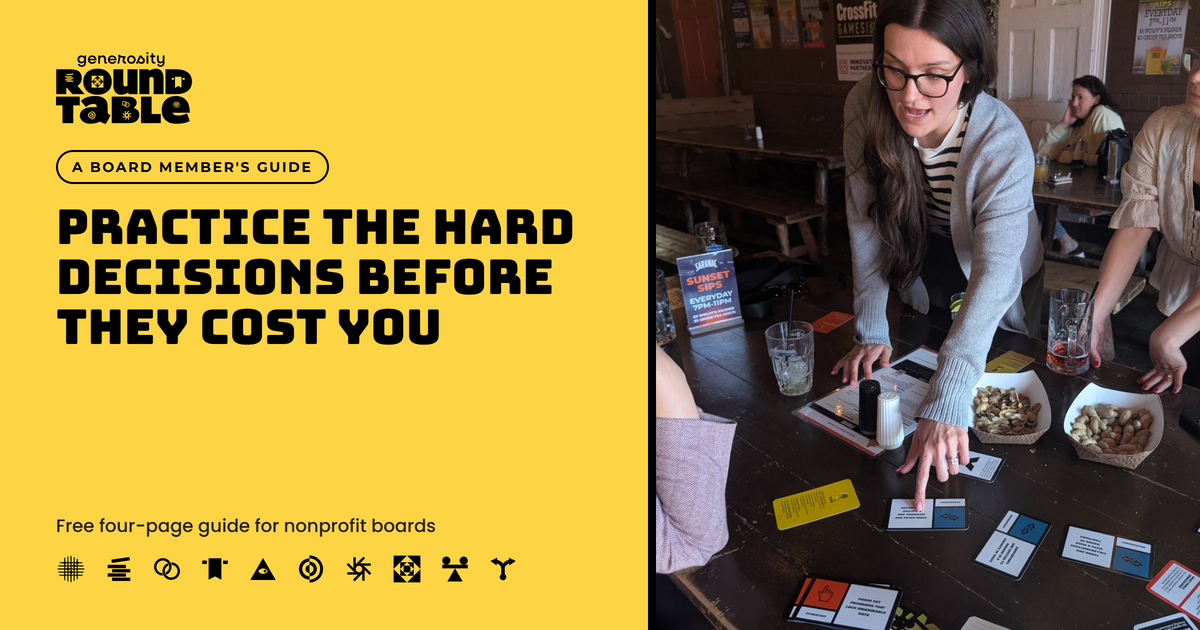
This is the companion to our new board member’s guide to the Generosity Roundtable. It walks through all four pages in one read, so you can see what an hour of practice gives back and why a $500 box earns its place in a nonprofit budget. The free PDF waits at the bottom, ready to share with your board.
Key takeaways
- Boards approve budgets, steward relationships and guard against risk, yet they rarely get to practice any of it together. The Generosity Roundtable gives them an hour to rehearse a real decision before it counts.
- Early playtests cut a strategic planning conversation from about two hours to about thirty minutes.
- Research on simulation training, donor connection and belonging at work all points the same way. Practice lowers risk, relationships grow revenue, and shared understanding heads off costly misunderstandings.
- The box is $500 once and comes with a lifelong Host license. Sending one person to a three-day national conference can cost $1,200 to $2,077.
- The free four-page guide ends with a copy-and-paste email you can send to your board chair this week.
Every idea a staff member brings to a board meets the same two questions. What will it cost, and what will we get back? They are fair questions, and the people asking them are trying to protect the mission. So we wrote a short guide that answers both plainly, with the research cited and the math shown.
The guide is four pages, and this post walks through each one. If you would rather start with the guide itself, skip to the free download at the bottom and come back here for the details.
Practice the hard decisions before they cost you
The Generosity Roundtable is an educational gaming system for nonprofit boards and teams. Three to five people sit around a table, and each one takes on a character shaped by one of ten Generosity Archetypes. Together they work through a real scenario using Conversation and Tactics cards, round by round, until the table reaches a decision. In about an hour, your board rehearses a choice before anyone has to make it for real.
Playing a character matters more than it sounds. It gives each person a little distance from their own title, so the treasurer can argue for a bold idea and the newest member can say what everyone else is thinking. More than four hundred people have played so far, and players give it a satisfaction score of nine or higher out of ten. What this means is the format works for people who have never touched a role-playing game, which describes most boards.
Rick Cohen, COO of the National Council of Nonprofits, put it this way. “Nonprofits that play this game with their staff can be better prepared for future challenges, build camaraderie, and provide professional development all in one fun exercise.”
Four returns on one box
Page two is the heart of the case. It names four things a board gets back from an hour at the table, and it pairs each one with a finding a skeptical board member can check.

1. It saves meeting time
In early playtests, the Roundtable cut a strategic planning conversation from about two hours to about thirty minutes. Traditional meetings debate what might happen. The game has the table simulate the decision, so everyone sees where the friction lives much sooner. What this means is a real question can fit inside one agenda item without needing a meeting of its own.
2. It lowers risk
A widely cited review of research on simulation games in workplace training, published in Personnel Psychology, found that people trained this way showed 14 percent more procedural knowledge and 9 percent better retention than people trained by other methods. What this means is the decisions your board has already rehearsed are the ones it handles best when they arrive for real. Safety is built in, too. Any player can use the X-Card to step back from a moment, so the conversation stays honest without wearing anyone down.
3. It grows revenue
Revenue grows out of relationships, and the numbers make that plain. In research from Charity Navigator and Mutiny Co., donors who felt very connected to a nonprofit gave about $1,376 a year, while donors who felt no connection at all gave about $181. That is roughly 7.6 times as much from the people who feel close to the work. The ten Generosity Archetypes give your board a shared language for why people give, which makes connection something you can plan for.
We watched this play out at the PANO Collaborative Conference this year. Four tables of Pennsylvania nonprofit leaders played the same case, a composite behavioral health nonprofit keeping only four of every ten donors. Each table worked on its own across three ten-minute rounds, and all four landed on the same idea. Donor trust gets rebuilt between the asks, and the whole organization owns it. Their choices became a free checklist that starts with three meaningful touches between every appeal, a thank-you, what the gift did, and what comes next.
4. It heads off costly misunderstandings
When people feel they belong at work, they stay longer and do better work. BetterUp’s research on belonging linked strong belonging to a 56 percent rise in job performance and a 50 percent drop in turnover risk. What this means is the misunderstandings that usually show up in a resignation letter or a lapsed donor show up at the table first, where they cost a laugh.
Play itself pulls its weight
None of these studies tested the Roundtable itself. Yet they point the same direction our playtests do, and two more studies show why the play is part of the point. Researchers at Brigham Young University found that teams who played a video game together for 45 minutes were 20 percent more productive on the task that followed. In a classic 1987 study, three out of four people solved a creative puzzle after watching a short comedy, compared with one in five after a neutral film. A little laughter makes room for better ideas.
What $500 buys your organization
The box is $500, one time, and it includes a lifelong Host license. There is no subscription to renew, and payment plans are available.

Every box includes three things.
- The game. A 55-card educational gaming system with 10 Archetype cards, 7 Scenario cards, 27 Tactics cards plus 3 blanks for your own ideas, Conversation cards and the X-Card.
- The Host kit. The Host Manual, Character Sheets, two character-building booklets, a canvas bag, a Sharpie, a sticker and, yes, a mint.
- The network. Membership in the Host Network, monthly virtual games, the Library of Generosity and a free Wiki for your whole organization.

Play once a month and the first year works out to about $42 a game. Every game after that adds nothing to the cost. These comparison rates come from our own benchmark of published 2025 and 2026 U.S. conference and training prices.
What a game looks like
A game runs about an hour. It opens with a warm-up game, then ten minutes of getting into character. Around the twenty-minute mark, the table starts three rounds on a real scenario, and near the fifty-minute mark the Host leads a learning summary of what surfaced. By the end of the hour you are done, and you will probably want to play again.
Questions your board will ask
Page four prepares you for the conversation itself, starting with the three questions boards tend to raise.
Will people really play a game?
Yes, and people of all ages love it. Each player takes on a character, which gives everyone a little distance from their own title and makes honest talk easier. More than four hundred people have played so far, with a satisfaction score of nine or higher out of ten.
Is it hard to learn?
No. A game takes about an hour for three to five players, and it opens with ten minutes of getting into character. The Host Manual, monthly peer discussions, in person and virtual games, and membership in the Host Network mean your Host never has to learn alone.
How do we pay for it?
It is one purchase with a license that never expires, and payment plans are available. Professional development funds are a natural fit, and a local business or funder can sponsor your box. You can also give a box to another nonprofit through our philanthropic program with The Connect Center.

Meghan Meyano, MSW, of IPH said it in one line. “This is so needed in a world of the same professional development webinars and courses recycled over and over again.”
Copy, paste, send
Subject: An hour for our board to practice the hard decisions
Hi [Name],
I found The Generosity Roundtable, an educational gaming system built for nonprofit boards and teams. We each take on a character and work through a real scenario together, so we can rehearse a decision before we make it for real.
The box is $500, one time, with a lifelong license. The attached guide shows how it saves meeting time, lowers risk and opens up new ideas for revenue.
Could we set aside an hour at an upcoming meeting to try it?
[Your name]
Where this is going
Boards carry a lot of weight, and they usually carry it with too little time and a lot at stake. An hour at the table will not make every decision easy. Yet it gives the people who care most about your mission a safe place to disagree, to hear each other out, and to meet the hard decision once before it counts.
So this week, download the guide, turn to page four, and send the email to your board chair. Then bring one question to your next board meeting. What is the decision you would most like to practice before you have to make it for real?
FAQ
What is the Generosity Roundtable? It is an educational gaming system for nonprofit boards and teams. Players take on characters shaped by ten Generosity Archetypes and work through a real scenario together, so they can rehearse a decision before making it for real.
How much does the Generosity Roundtable cost? The box is $500, one time, and it includes a lifelong Host license, so there is no subscription. Payment plans are available, and a local business or funder can sponsor a box for your organization.
How long does a game take, and how many people can play? A game takes about an hour. A table works best with three to five players and can hold up to ten.
Do we need a professional facilitator? No. Your Host runs the game with the Host Manual, with the Host Network and monthly virtual games for support. During workshops, we have onboarded new Hosts in as little as fifteen minutes. If you can lead a discussion, you can Host the game.
Is the Roundtable only for fundraising? No. It is a role-play system for exploring generosity, identity and trust, and its Tactics cards cover communications, engagement and operations. These traits are inside all of us, not just those with the word "development" in our title.
Download the board member’s guide
Four pages, free to share. Download the PDF and bring it to your next board meeting.


