Pennsylvania Nonprofit Leaders Agreed That Donor Trust Gets Rebuilt Between the Asks
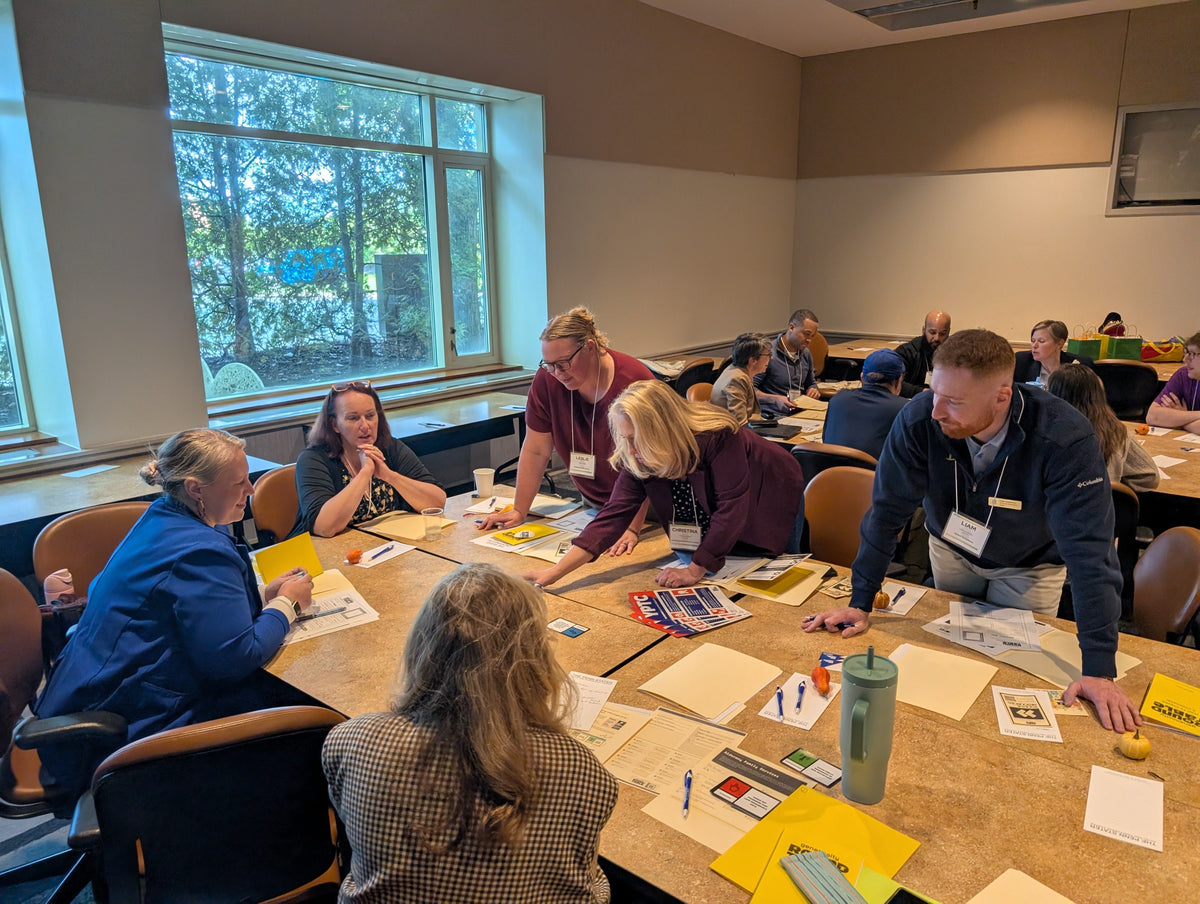
Field notes from The Generosity Roundtable at PANO's 2026 Collaborative Conference, where four tables of Pennsylvania nonprofit leaders played their way to a plan for rekindling trust with the donors an organization let drift.
Key Takeaways
- Across four tables, Pennsylvania nonprofit leaders kept arriving at the same idea, that donor trust gets rebuilt in the space between asks, through consistent and honest contact owned by the whole organization.
- Every table played the same composite organization, Alderway Family Services, a behavioral health nonprofit that keeps about four of every ten donors from one year to the next.
- Three of the four tables built structure before choosing tactics, calling for shared systems, a cross-functional working committee, or set steps after every donor interaction.
- Every table chose to build a composite character who was also a client, or the parent of one, and those characters shaped what each table was willing to say in public.
- The most deliberate table committed to at least three meaningful touches between every ask, a real plan for lapsed donors, and a finance-led review of which programs earn expansion.
- Across the room, honest storytelling tied to evidence beat success-only messaging and automated shortcuts.
The tavern was never about the drinks
In the years around the Revolution, Pennsylvanians did a remarkable amount of their civic thinking in taverns. Philadelphia's City Tavern hosted delegates to the First Continental Congress in 1774, and smaller rooms across the colony often doubled as meeting hall, message board, and newsroom. People came in from the cold, found a seat next to someone they didn't fully agree with, and worked out what to do next. That is the room I keep trying to rebuild. I'm a sober guy, so my version pours coffee and attention, and it can be set up anywhere there are a few tables and a deck of cards.
On September 24, that room was a ballroom at the Penn Stater in State College during the Pennsylvania Association of Nonprofit Organizations' Collaborative Conference, themed Rooting Deeper, Rising Together. I dimmed the lights down to something close to candlelight, and the hotel staff seemed to enjoy the tavern lighting nearly as much as the players did. The day also brought me back to Anne Gingerich and the PANO team, and to Diane Yentel of the National Council of Nonprofits. I hadn't been on a program with them since hosting both at the largest virtual conference my former company ever ran, which also became its highest-rated and most engaged. Bringing this work back to them almost a year later was an honor.
Building a tavern that travels
Running a game for one table is a craft. Running it for a whole room is logistics, and we've spent this year learning the difference. Our first large-group test in May was messier than I wanted. By July, at the Bridge Conference, our mix of printed cards, digital prompts, and a trained host at every table held together at our biggest scale yet, and I'll unpack that session in a longer breakout soon. State College was the first time the format felt like something a room could simply walk into.
That readiness came from stepping back. We looked across everything we'd run, from GivingTuesday gatherings to AFP ICON in April to one-on-one sessions, and asked what it would take to turn it into a repeatable structure. The timing matters. The National Council of Nonprofits is talking about launching community forums. Weavers are gathering neighbors through the Aspen Institute's Weave project, GivingTuesday communities are convening locally, and on the technology side there are CauseVox gatherings, We Are For Good meetups, and a full calendar of vendor gatherings. Yet the most consistent thing I hear from the people who actually attend is that they can't see how the conversation connects to the work their peers are doing.
The Roundtable is built for that gap. If someone wants to call it a facilitation tool, I'm fine with that. Underneath, the design gives any group a shared mechanic for talking about generosity, with the same case, the same three decisions, and the same learning summary, so a table in State College can be read alongside a table in Schenectady or Chicago. It's also why you'll see more of these summaries here, and soon from more voices than mine. I'm building a process for Hosts in our network to turn their own sessions into written summaries for this blog, and I want that process to be worth their time.
The case on the table
Every table played Alderway Family Services, a composite behavioral health and family support organization in central Pennsylvania, built from national benchmarks drawn from M+R Benchmarks, the Fundraising Effectiveness Project, and Candid. On paper it looks steady, with $8.5 million in revenue, about 55 staff, and a fully established board. Yet 83 percent of that revenue comes from program services, mostly Medicaid and county contracts, while contributions bring in just 12 percent. Pennsylvania's nonprofit sector as a whole draws roughly 69 percent of its income from program fees and contracts, so the shape of Alderway's budget felt familiar to a lot of people in the room.
The donor numbers are where the ground starts to shift. Alderway keeps about four of every ten donors from one year to the next, which means six of every ten people who trusted it with a gift last year didn't give again. Its list of roughly 15,000 supporters sheds about one in six names a year without upkeep, which works out to around 2,500 people drifting away without anyone noticing. Only about one in seven people in its database is involved in any way beyond giving. The card asked each table how Alderway could rekindle trust with the people it let drift and grow its base, and whether its own past practices had quietly shut people out.
Nobody at these tables was playing themselves. Each table had a Host and five or six guests, and every guest built a composite character on the spot from our archetype cards (you can find your own starting point with the Generosity Archetype quiz), with a role, green flags, red flags, and a personal connection to the cause. Everyone named in this summary is one of those invented characters, drawn from the players' experience but belonging to no real person.
Over three rounds of about ten minutes each, the tables chose one tactic card for Communications, one for Engagement, and one for Operations, with each round pulling between two good instincts: being specific or broadening the message, investing in current relationships or reaching new people, staffing for the long haul or using what we have.

Three tables built the frame before hanging the picture
The pattern I didn't expect was how quickly most of the room reached past the tactic cards toward structure. One table landed on agreed-upon systems, with checks and balances, that empowered staff could then use to engage donors and grow their generosity. Another decided Alderway should identify a leader in each division and form a working committee across them. A third chose structured steps after each donor interaction and summed up its session as "structure and steps."
What this tells me is that the people closest to this work don't see plateaued engagement as a messaging problem first. Donors tend to drift in the handoffs, when the program team knows the story, the finance team knows the numbers, and development knows the donor, but nobody is holding all three at once. A cross-functional committee sounds unglamorous. Yet it's the piece that lets a thank-you note carry a real program update and lets an impact report carry a real number, and three tables out of four arrived there on their own.
Clients kept pulling up a chair
The characters are invented, and the choices behind them tell us something real. Left free to build anyone they liked, players at every table created a character who was also on the receiving end of Alderway's services. One player built a volunteer leader who had once been a client. Another built Alderway's largest donor as a parent whose children had been through its family counseling. A third built a CFO who was raising a child with behavioral health needs. Nobody was assigned those backstories, and the players reached for them anyway, which says a lot about who they picture when they think about the people behind a gift. When the tables reported out, several said directly that Alderway's planning and storytelling need to bring the people it serves into the planning and the storytelling as participants.
At a human services organization, the line between donor, client, and volunteer blurs, and retention strategies that treat donors as a separate audience miss the people who already know the work from the inside. The donor characters pressed the same point from another direction. One player's donor wrote "Why do I care? What benefits me?" on the character sheet, and another player's donor listed their connection to the cause as simply wanting to see where the money is going. Put those voices at the same table as a former client and the question shifts from how to ask better to who belongs in the conversation before the ask.

The table that took its time
Table 4 was the last to finish, and the reason was worth the wait. They weren't circling. They went deeper than any other table, turning each round into steps Alderway could put on a calendar. The characters at that table included a volunteer, a donor in the Evaluator role, a second volunteer as the Ambassador, a staff member as another Evaluator, and a CFO as the Builder, which may be the most cross-functional cast we've ever had at a single table.

The three-touch rule is the clearest version of what the whole room kept circling, that trust gets rebuilt between the asks, and it's the line I'd hand every development director in the state. Nationally, fewer than one in five first-time donors give a second time, a pattern I dug into in our last learning summary on community theater, and in the Fundraising Effectiveness Project data that second gift is where long-term relationships are won or lost. Three meaningful touches before the next ask turns stewardship from a good intention into a schedule someone owns. The operations answer is just as telling. The table gave the CFO a seat at the storytelling table, because the only way to tell donors honestly what worked is to know which programs are actually working.
Honesty kept winning
One of the tactic cards in play would have limited Alderway's public storytelling to success outcomes. The room kept pushing against it. Table 4 wanted a newsletter that isn't only positive. Another table chose to phase out programs that lack data before expanding anything, and summed up its learning as a plan to "use measurable data to prove community impact and request dollars to support through storytelling and community advocacy." A third table pushed back on a card that would have used chatbots to recommend giving opportunities, preferring to evaluate programs on measurable performance first.
I read that pushback as a point about sequence. These players were fine with tools that help an organization read its own data and make sense of it. What they wouldn't hand off was the relationship itself. For an organization that has let donors drift, the first repair is showing them the real picture, and a donor who hears about a program that struggled and changed course has more reason to trust the next success story. Very pertinent insight as we gear up to hear more and more about agentic giving.
A checklist for Monday morning

Back to the tavern
The old taverns worked because people who didn't share every view still shared a table, and they stayed long enough to decide something together. That's what I watched happen in State College. Four tables of people who mostly didn't know each other agreed that trust gets rebuilt between the asks, by the whole organization, with the people it serves in the room. Before your next appeal goes out, look at the last three things your lapsed donors heard from you and check whether any of them told the truth about the work.
Who in your organization's story has been giving to you for years, in time or trust or dollars, and when did you last ask them to pull up a chair?
This learning summary joins the Library of Generosity on The Generosity Compass, our growing record of certified Generosity Roundtable sessions. Thank you to Anne Gingerich, the PANO team, the Penn Stater staff, and every Host and guest who played. If you'd like to bring the Alderway case to your own community, the Generosity Roundtable Host Network is where to start.


